

Queenballer's guide to the NWSL’s complicated spending rules

While most leagues in the world allow clubs to spend as much as they’re willing to build their squad, the NWSL in the United States follows a time-honored American sports tradition: a salary cap.
When the league first started play in 2013, the salary cap was $200,000 with a maximum salary of $30,000 for a single player. Since then, the salary cap and overall spending rules have evolved into something much more complicated, yet much more sustainable for a player to make a reasonable living off of playing football professionally.
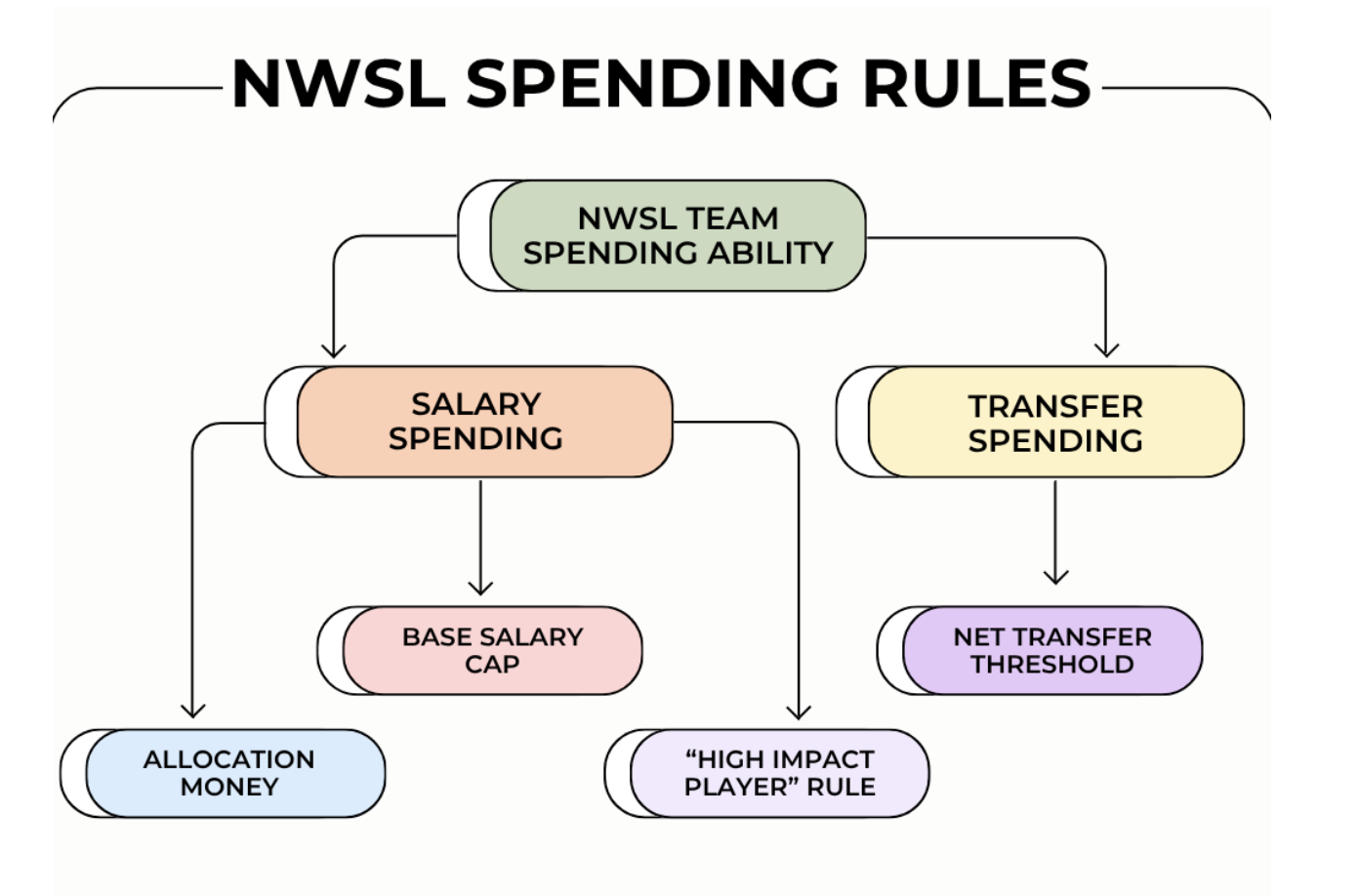
So what are all of these spending mechanisms?
Salary Cap
The simplest part of the NWSL’s spending rules is its salary cap, which is the lowest salary ceiling that a club will be subjected to. It rises every year — for the 2026 season, it is set at $3.7 million, and it will rise to $4.4 million in 2027.
NWSL rosters are made up of anywhere from 22 to 26 players, and clubs will have at the very least that base salary cap amount to spend on player wages. Clubs are not obligated to spend at or near the cap level, but there is a minimum individual salary of $50,500 in 2026, which will go up to $65,000 in 2027.
Beyond this, there are other ways for clubs to legally host a wage bill that goes over the base salary cap.
Allocation Money
The first mechanism that the NWSL implemented for clubs to spend over the salary cap was allocation money. Introduced ahead of the 2020 season, allocation money was a resource that clubs could purchase to spend over the cap. In that first year, clubs could buy up to $300,000 that they could spend over the salary cap. That amount went up by $100,000 each year until 2023, the last year that it was offered.
Starting in 2024, teams could no longer purchase allocation money. Furthermore, the remaining allocation money had to be used by the end of the 2026 calendar year. An exception was made for expansion teams Boston Legacy and Denver Summit; because they didn’t join the league until 2026, they were given the option to purchase special expansion allocation money that wouldn’t expire until the end of the 2027 calendar year.
Aside from allowing teams to spend over the salary cap, allocation money has proven to be a useful asset in trades, especially following the elimination of the NWSL college draft. For example, Boston Legacy FC recently sent Gotham FC $350,000 in expansion allocation money in exchange for promising young defender Lilly Reale.
High Impact Player (HIP)
As of July 1st, 2026, the NWSL has a new mechanism for allowing teams to spend beyond the salary cap. The “High Impact Player” (HIP) rule allows teams to spend up to $1 million over the cap under very specific conditions, with the $1 million number set to grow year-over-year at the same rate as the base salary cap.
Players are eligible to have part of their salaries covered only if they are on the NWSL’s “High Impact Player” list. Ways to make this list include but are not limited to being selected for end-of-season awards in the past two years, being included on high profile rankings of top players globally in the past two years, and being in the top 11 field players by minutes played in the past two years for the USWNT.
If a player meets one or more of the above criteria, they still have to be making at least 12 percent of the base salary cap. For 2026, that number would be $444,000, and for 2027, it would be $528,000. The $1 million HIP money can be spent on any salary exceeding that 12 percent salary cap hit. HIP money can be spent on multiple players.
Net transfer threshold
The last complicated spending mechanism of the league relates to spending on transfers. Specifically, clubs are required to strike a specific balance with their transfer money in and transfer money out. The net transfer fee threshold allows the difference between a club’s transfer spending and its transfer revenue to not exceed a specific amount. If that difference exceeds the net transfer fee threshold, clubs will incur a 25 percent charge against their salary cap for the excess amount.
The net transfer threshold started out as $500,000 in the 2024 season and will increase 10 percent year-over-year for the duration of the current Collective Bargaining Agreement (CBA) which is set to run through 2030. As such, the 2026 figure is $605,000, and it will go up to $665,000 in 2027.
The NWSL put spending rules into place to ensure financial stability for clubs and manufacture parity among clubs, making the league unique on the international level. As salaries and transfer spending rise worldwide, the league has implemented addendums to spending limits to allow NWSL clubs to compete with clubs not facing any restrictions. Time will tell if the league is adapting fast enough to avoid losing its top talent to clubs abroad.