“My name is Leah Williamson, and I won the European Championship with England. At a time when I was on my period.”
With these words, the Lionesses captain launched a new campaign. Arsenal Women, in collaboration with Persil, are working to destigmatise period and the difficulties associated with it and other gynaecological issues in women’s sport.
The campaign Every stain is a part of the game, introduced by Arsenal in March this year, was far from the first time women’s football addressed period taboos or opened up the wider topic of women’s health.
Leah Williamson in particular — captain of the Lionesses and one of the most iconic players of the modern era — brought this issue into the spotlight shortly after becoming the first England captain ever to lead the team to a European Championship title in 2022 at a sold-out Wembley.
Williamson suffers from endometriosis, a gynaecological condition that, among other things, causes heavy periods accompanied by painful cramps. Her situation was further complicated by a concussion sustained shortly before the Euros, which can also intensify menstrual cramps.
It came dangerously close to preventing her from experiencing one of the biggest successes of her life. “Throughout the whole tournament, I was terrified that instead of being on the pitch, I’d end up curled up in pain in the bathroom. So many times I’d be lying there unable to move, and by then it was already too late to take any medication,” the European champion told Women’s Health after the tournament.
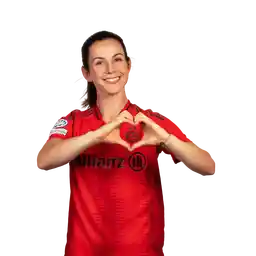
Williamson is not the only one professional footballer affected by the condition. Bayern Munich defender Tuva Hansen also raises the topic frequently on her social media. In an interview with the Norwegian daily Verdens Gang, she revealed that from her very first periods she experienced severe pain that made it impossible for her to attend school or football training.
She recently underwent surgery and shared the entire process — including recovery — on her TikTok account, known to fans as “TuvaTok.” Clubs are increasingly responding to the growing visibility and open discussion championed by players like Williamson and Hansen. At Bayern, for instance, physiotherapists monitor each player’s menstrual cycle, and training sessions are adjusted accordingly. The club is said to work with an endometriosis specialist who supports Hansen and other players dealing with similar issues.
A landmark moment in breaking period taboos also came with the Czech brand Snuggs partnering with Manchester City, making it the first global period underwear brand to officially collaborate with a professional football club. Others soon followed.
At the start of the season, West Ham United announced a partnership with Modibodi, which produces period-proof underwear and became the first on-kit partner in women’s football to feature branded period-proof apparel in match uniforms. Chelsea did not lag behind either, collaborating with the female-owned and women-led period care brand Here We Flo.
Partnerships like these show that women’s football is successfully dismantling one taboo after another. The sport’s growth illustrates that it’s about more than football alone — players are also bringing attention to issues that, until now, never had a true spotlight.