

Wasn’t meant to be as a player. So she made history as a coach: The story of Elena Sadiku

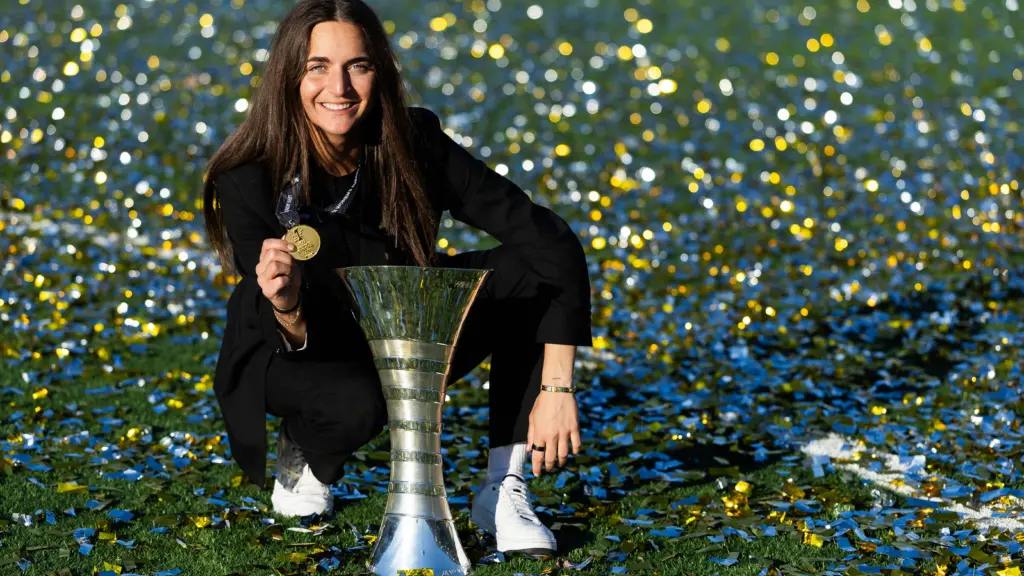
On Friday, 1 May 2026, Elena Sadiku lifted the first-ever Europa Cup trophy together with her Häcken side, just months after taking over the team in December 2025. In her previous role at Celtic, she had already made history by delivering the club’s first-ever title in the Scottish Women's Premier League. Yet as a player, her own journey was cut short, forced to retire at just 23 after suffering her third ACL injury. What is the story of Elena Sadiku?
As women’s football continues to grow, so does the number of female coaches shaping the game. Names like Emma Hayes, Sarina Wiegman or Renée Slegers have already carved out remarkable careers on the touchline. Elena Sadiku shares something in common with Slegers. Both were forced to end their playing careers early due to injuries, yet went on to become European champions as coaches.
At just 32, Sadiku could easily have been playing celebrating alongside Kosovare Asllani and Fridolina Rolfö perhaps a World Cup bronze in 2023 or even an Olympic silver from Tokyo with the national team. She represented Sweden at youth level, but never had the chance to fight for a place in the senior national team.
Fate had other plans
Her first ACL injury came at 20, sidelining her for a year. In isolation, that setback might not have defined her career, many players suffered ACL and still were able to return. And Sadiku did return in style, marking her comeback with a hat-trick. But the comeback did not last long. A second ACL injury followed soon after.
Two long-term injuries in quick succession — at a time when a player is physically and mentally at their peak — took a heavy toll. Still, Sadiku refused to give up. She returned once again, this time joining Swedish giants Hammarby. But she wasn't meant to be big player.
She made just six league appearances before suffering a third ACL injury, this time in a Stockholm derby against Djurgården. That proved to be the breaking point. At just 23, Sadiku made the difficult decision to retire.
Not the end
But her story did not end there. Her first steps into coaching came in an unexpected place, China, before she returned to Sweden as an assistant coach at Rosengård, the club where she had made her senior debut as a player. (The club was named LdB Malmö back then).
The real turning point in her coaching career came in January 2024. At just 30 years old, Sadiku became the first woman to take charge of Celtic’s women’s team.
Despite her age, she already had European experience, having guided Fortuna Hjørring to the UEFA Women's Champions League quarter-finals. She brought that winning mentality to Celtic, leading the club to its first-ever Scottish Women’s Premier League title and, with it, a place in the Women's Champions League.
They made it to the group stage but the draw was unforgiving. Up against Chelsea, Real Madrid and Twente, Celtic finished bottom of the group without a point and only one goal scored. Sadiku later admitted that while she was proud of her players, the results were disappointing.
Domestically, too, things did not go as planned, with Celtic finishing below expectations fourth. The partnership came to an end, and Sadiku returned home to Sweden. To BK Häcken
Next challenge: European title
The expectations were high. Häcken were reigning Swedish champions and among the favourites for the Europa Cup title. Sadiku was appointed in December, and although the domestic season would not begin until March, her first real test came quickly - a Europa Cup quarter-final against Breiðablik.
Häcken passed it with ease, winning 11:1, before overcoming Eintracht Frankfurt to reach the final. Waiting for them there was Hammarby, the club where Sadiku’s playing career had ended.
The two-legged final concluded on 1 May 2026 in Göteborg, where Häcken made history as the first-ever Europa Cup winners. Felicia Schröder’s hattrick sealed the victory and delivered Sadiku her first European trophy as a head coach. For both club and coach, it was a landmark achievement.
Sadiku may not have fulfilled her potential as a player, but she has more than found her place in coaching. Younger than some players still active on the pitch, she has already broken barriers and rewritten parts of the game’s history.
Her story is a reminder that sometimes we don’t reach the path we once imagined. But that doesn’t mean the journey ends. Sometimes, it simply leads somewhere else — somewhere just as extraordinary.