How have attendances in the Women's Super League changed over time?

Author: Ayisha Gulati
The Women’s Super League (WSL) is widely considered the fastest-growing and most followed women's football league in the world. Over the past decade, attendances have risen dramatically, with the league now attracting the world’s best talent and boasting 103m followers globally. While growth has been rapid, recent figures suggest that attendances may now be entering a period of stabilisation.
What do the numbers show?
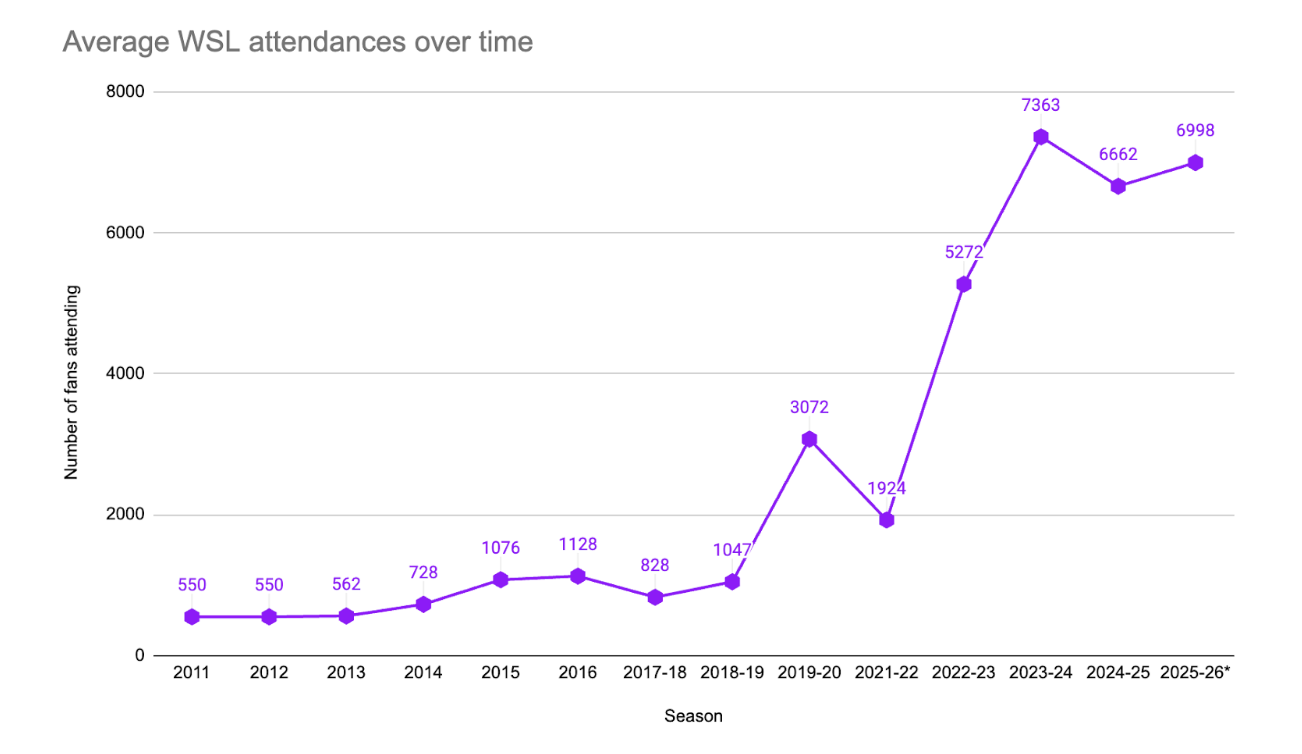
When the WSL launched in 2010, average attendances were around 500. For much of its early existence, the league attracted relatively small crowds, with limited media exposure and little commercial backing.
The first notable increase came following the 2019 Women’s World Cup in France, where England reached the semi-finals before losing to eventual winners the USA.
There was an incredible 175% increase between the 2021-22 and 2022-23 seasons, following the Lionesses’ Euro 2022 victory.
The tournament was a watershed moment for women’s football in England, with a record-breaking crowd of 87,192 attending the final at Wembley and the success of the Lionesses significantly boosting interest in the domestic game.
This surge was also driven by factors including increased broadcast coverage, greater visibility of players, and more ambitious club marketing strategies. Teams hosted more matches at their main stadiums, promoted fixtures as headline events, and introduced ticket and matchday initiatives to attract new audiences.
Growth has stagnated
Despite the post-Euro 2022 boost, recent data suggests growth is levelling off. Since the 2023/24 season, growth has begun to plateau. Last season, the WSL average attendance dropped 10% on the previous season from 7,366 to 6,662.
A key reason for this was the relegation of Bristol City, who had the fifth-highest average home attendance in the league, attracting crowds to Ashton Gate. Their replacement, Crystal Palace, attracted significantly smaller crowds, of around 5000 less, lowering the overall average.
There are also broader challenges affecting attendance figures. This season, concerns have been raised about Sunday lunchtime kick-off times, a slot Sky has chosen as most suitable for broadcast, which often limits in-person accessibility for fans.
With more matches broadcast on television, supporters may be opting to watch from home rather than attend in person.
Arsenal lead the way
Arsenal are doing a lot of the heavy lifting when it comes to average league attendances. This season sees them playing all 11 of their WSL matches at Emirates Stadium.
Last season, their average home attendance at the Emirates was 34,110 across the nine league games they played there. This season, this has risen to 36,836, a number higher than eight Premier League clubs.
Arsenal's average attendance is more than three times higher than that of next-best club Chelsea.
How does the WSL compare globally?
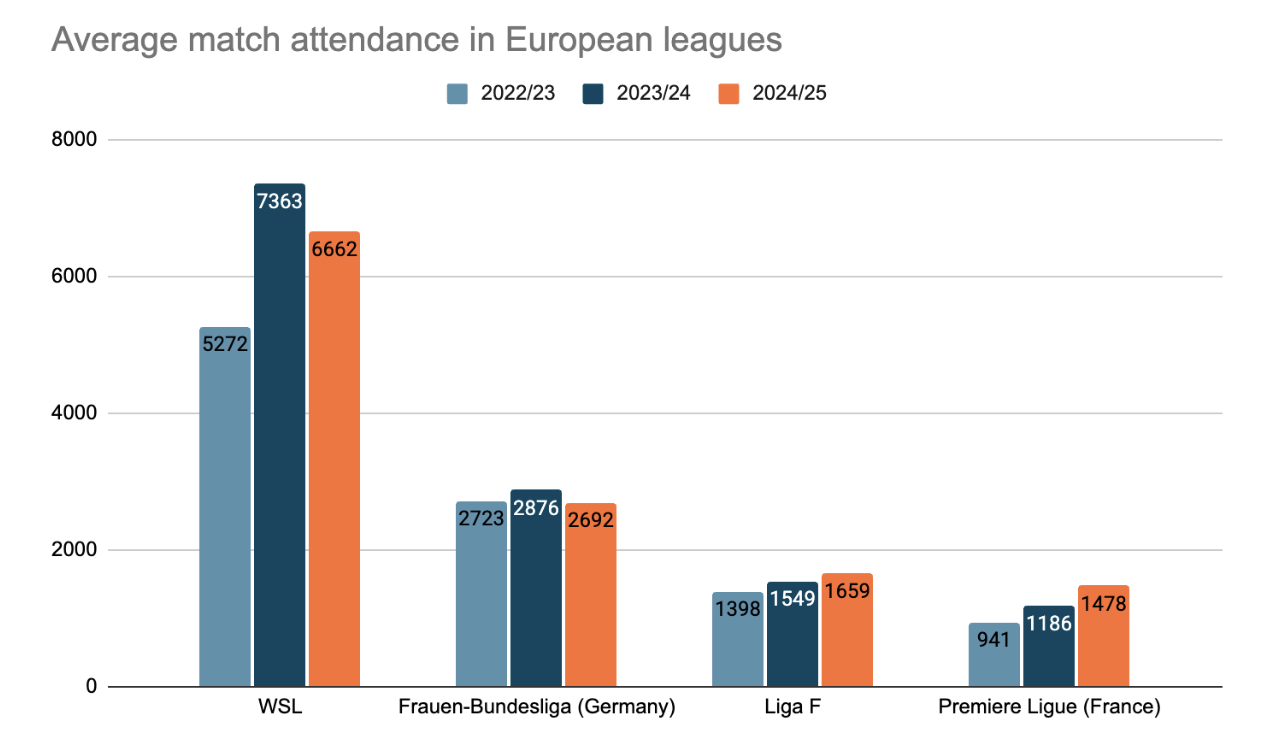
In a global context, the WSL remains the strongest league in Europe, although it still trails the USA’s National Women’s Soccer League (NWSL), which recorded an average attendance of 10,583 last season.
However, no NWSL team can compete with Arsenal’s figures - Portland Thorns came closest at 18,173 in 2025.
Spain’s Liga F, home to Barcelona, recorded an average attendance of just 1,659 last season, with Germany’s Frauen-Bundesliga and France’s Premiere Ligue also lagging behind the WSL.
The WSL and its clubs continue to explore ways of boosting attendances - from stadium choices to broadcast picks and kick-off times. But the challenge now is turning record interest into consistent matchday attendance.