When football belonged to men only: The moving story of Italy's first female footballers
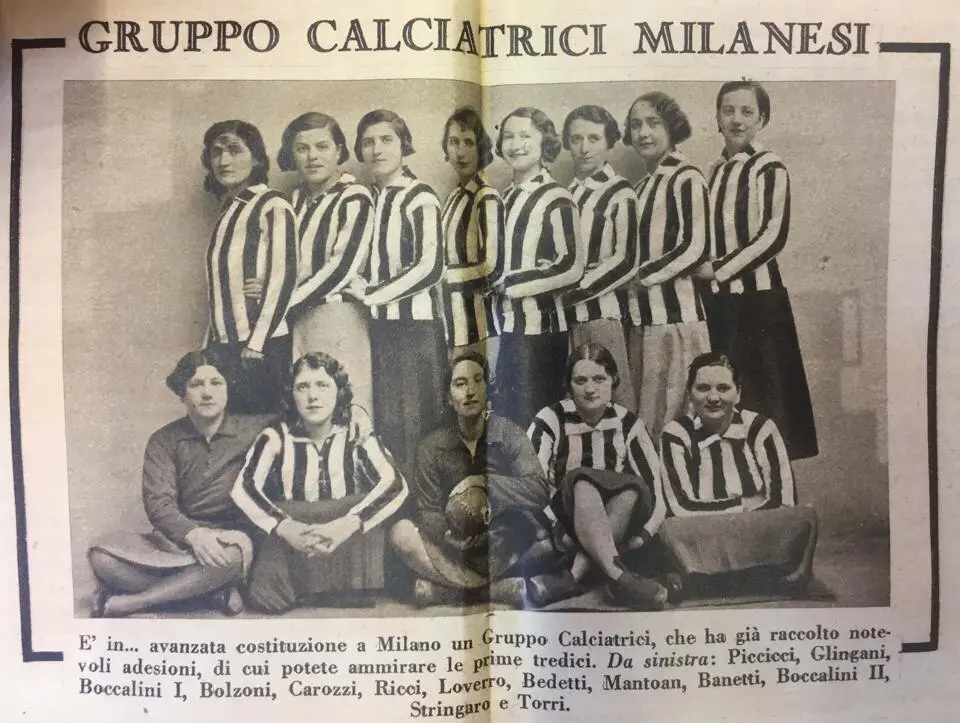
In the summer of 1932, several young women from Milan were spending their vacation near Livorno. As die-hard football fans, they began playing football for fun on a small field near the beach. What started as a simple vacation pastime gradually gave rise to a bold idea: to found the first women’s football club in Italy.
A few months later, in February 1933, the Gruppo Femminile Calcistico (GFC) was established in Milan. Not only was this the first organized women’s football team in the country, but the way it came into being was also exceptional: “Unlike most women’s sports activities during the Fascist era, this was not a project imposed from above. It arose from the initiative of the girls themselves,” explains historian Marco Giani.
The ban on fans didn't last long
At the heart of it all were the Boccalini sisters: Marta, Giovanna, Luisa, and Rosetta, who became the driving force behind the entire initiative. In a relatively short time, the club grew to 50 members and they managed to secure jerseys and football boots, as well as rent a field. The female footballers were just as active in the media. They sent letters to various newspapers, including a photo of the entire team, hoping that at least some magazines would take notice. At the same time, to make everything official, the girls applied to the Fascist authorities for permission to operate.
The request eventually reached the desk of Leandro Arpinati, then president of both the Italian Olympic Committee (CONI) and the Italian Football Federation (FIGC). Many expected a rejection. Arpinati, however, surprised everyone and gave women’s football the green light, although only under strict and rather humiliating conditions. The most significant of these was that matches were to be played behind closed doors, that is, without spectators, although this rule was not strictly enforced in the end, and family members and friends of the players were allowed to attend the matches.
However, the ban on spectators wasn’t the only peculiarity that the female footballers had to accept. Each half could last no more than twenty minutes, they played with a smaller ball, were allowed only ground passes, had to wear skirts below the knee instead of shorts, and boys from the Ambrosiana-Inter youth team had to stand between the posts, as it was believed that any ball striking the goalkeeper’s body could impair her reproductive abilities. The skirts gradually evolved into skirt-pants, but other absurd rules remained.
And what were the matches actually like? At first, they were mostly practice matches within the club. The girls from the GFC formed several teams, which played against each other in different jerseys. The very first official match, held in June 1933 between two GFC teams, Gruppo Sportivo Ambrosiano and Gruppo Sportivo Cinzano, was also played in this spirit. The game, watched by about a thousand curious spectators, was ultimately won by Cinzano with a score of 1–0. The great public interest is also confirmed by the fact that the prestigious Il Calcio Illustrato, the only magazine that treated Milan’s female footballers with respect, published a report on the match for its readers.
And it was precisely for Il Calcio Illustrato that Rosetta Boccalini made the statement that, in the shadow of the events to come, would become legendary: “I love football very much, it is my enduring love, not just a flash in the pan. My teammates have so much passion and goodwill. We will never fade away.” The second official match between the same teams took place a few weeks later. Interestingly, a delegation from the Czech club Sparta Prague also came to watch the game, as they were in Italy at the time due to the ongoing Mitropa Cup.
A violent end instead of development
However, as news of the founding of the country’s first women’s football club quickly spread throughout Italy, similar initiatives began to emerge elsewhere on the Apennine Peninsula, particularly in the north and in Rome. One of the most ambitious clubs was founded in Alessandria, with which GFC quickly forged ties, and the first match between the two teams was scheduled for October 1. Everyone sensed what a huge step this could be for Italian women’s football. However, the Italian Fascist regime decided to strike a heavy blow against the sport, the consequences of which Italian women’s football continues to feel to this day.
Leandro Arpinati, who had originally granted women’s football limited approval, had in the meantime lost his influence. Following his downfall, Achille Starace, one of the highest-ranking officials of the Fascist regime, took over as head of the Italian Olympic Committee (CONI). The new leadership had no sympathy for women’s football. Two days before the scheduled match, the authorities canceled the game in Alessandria, and on November 22, 1933, women’s football was definitively banned in Italy.
The main reasons for the ban were essentially two. The fascist regime viewed women primarily as future wives and mothers, and therefore considered football to be a sport incompatible with that role. The second reason was the upcoming 1936 Olympics in Berlin, which were intended to serve as a showcase for the achievements of rising totalitarian regimes, thereby strengthening their legitimacy in the eyes of the world. Achille Starace thus sought to support only those sports in which Italian women could bring international success to the regime and thereby bolster its propaganda.
The footballers then moved primarily to athletics and basketball, where some of them achieved significant national and international success: The club’s star player, Rosetta Boccalini, won three titles with the Ambrosiana basketball club, and Amelia Piccinini from Alessandria won a silver medal in the shot put at the 1948 Olympic Games.
Pioneers' legacy has not been forgotten
Yet the pioneers of Italian women’s football have not been forgotten, even though they had to wait a very long time for recognition. In 2020, in Lodi, where the Boccalini sisters were originally from, a commemorative match was held between Alessandria and Partizan Bonola Milano, symbolically recalling the match between Alessandria and GFC from 1933 that was never played. Young female footballers took to the field that day to pay tribute to the women whom the fascist regime had prevented from playing football almost ninety years ago. A year later, the city of Milan honored their legacy permanently by naming a street near Sempione Park after the 1933 footballers and unveiling a memorial column commemorating their courage and significance to the history of Italian women’s football.