
There’s nobody like Alexia Putellas

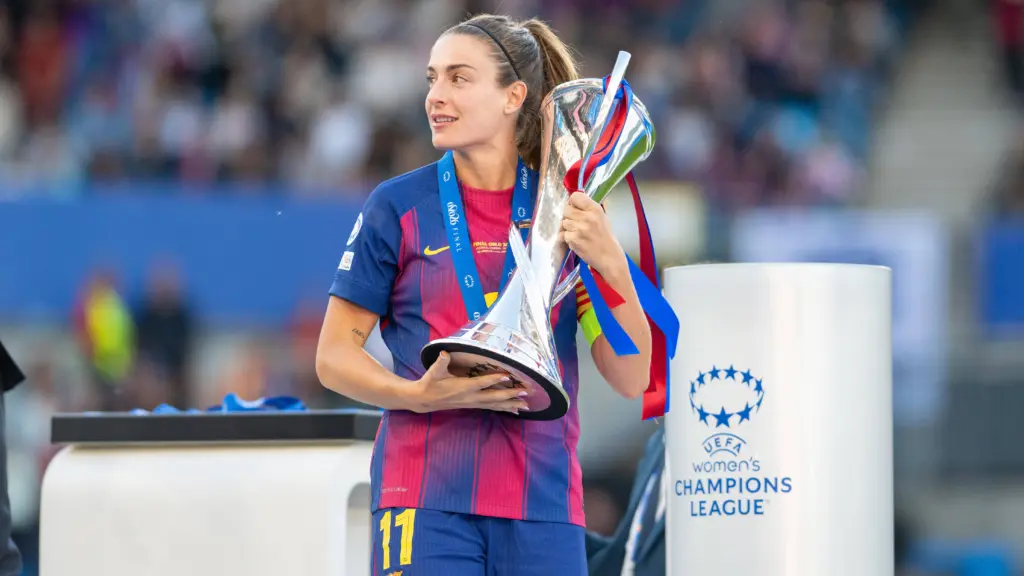
Although it had been rumored about for a long time, few could truly imagine it happening. But it did. On 26 May 2026, Alexia Putellas left Barcelona, her childhood club, after 14 seasons. Over that time, her persona became almost synonymous with Barcelona Femení. Whether you are a fan of hers or not, one thing is undeniable: she made countless people to love women’s football.
While the news of Putellas’ departure understandably left many fans heartbroken, there is at least some comfort in the fact that she leaves at the very top. A domestic treble, the fourth Champions League title and, perhaps most importantly, several sold-out nights at Camp Nou chanting her name. Like they used for Lionel Messi years ago.
Putellas’ final appearance at Barcelona’s main stadium came in the UEFA Women's Champions League semi-final against Bayern, where her two goals sent Barça into the final. When she left the pitch in the 86th minute, the emotion in her eyes was impossible to miss, and once again, she was met with a deafening ovation from a sold-out stadium.
Nobody like La Reina
Commentator Janelly Farías summed up the moment in the studio: “Everything that she transmits to the fans speaks volumes of who she is as a player, as a person and everything she has done for Barcelona and women’s football. There is nobody like Alexia Putellas.”
Because in modern women’s football, Putellas is not just a player defined by numbers that place her among the greatest footballers of all time. She is one of the reasons women’s football stopped apologising for its existence and began claiming space as if it had always belonged there.
Her significance cannot be measured only in trophies, even if those numbers are absurd. More than 500 appearances for Barcelona, a club-record 233 goals, ten league titles, four Champions League triumphs and two Ballon d’Or awards. Alexia was also the first Spanish woman to win the Ballon d’Or.
Her face is familiar even to people who have never followed women’s football. She appeared on billboards and in major campaigns, most recently alongside Leah Williamson and David Beckham for Pepsi, and became one of Nike’s leading faces. She appeared on the covers of sports magazines that had once given women’s football almost no space at all. She had her own documentary, and a feature film about her is now in the making.
For young girls, she became the first female footballer they could instantly name and who is their first role model. And for parts of the wider public, she was the first moment they truly allowed themselves to see women’s football as culturally relevant.
Not every player changes the way people see an entire sport. Putellas did. Sold-out Camp Nou nights were not a coincidence or a marketing experiment. They were proof that women’s football had finally stopped being treated as something “less”. And Putellas was its most visible face.
Perhaps that is why she is respected far beyond the women’s football community. Even by people who do not usually follow the game, or who have been critical of it. Alexia never seemed like someone demanding respect. More like someone people gradually realised they had no choice but to give it to.
Her personality helped, too. In an era of social media, constant content and players building their own brands, Putellas often felt strikingly calm. She did not need to be the loudest person in the room. She was never untouchable, yet she carried a certain aura. That mix of elegance, professionalism and fierce competitiveness turned her into a figure who transcended the sport itself.
Maybe that is why her return from an ACL injury in 2023 resonated so deeply. Not because of the simplistic “stronger after the fall” narrative sport is so often forced into. But because it was obvious how much women’s football needed her presence. Not just Barcelona, the entire ecosystem around the game.
When Spain won the World Cup in 2023, Putellas was no longer the team’s only star. She was still returning from injury, and her role at the tournament was not what she, or the fans, would have wanted. Women’s football had moved on. New generations had arrived. New personalities had emerged. And yet she remained its most recognisable face. The player who connected the era of matches played in front of a few hundred people with the reality of sold-out stadiums and million-strong television audiences.
Next step?
That is why her departure from Barcelona feels both symbolic and painful. It is not just a captain leaving. It is a player whose career mirrored women’s football’s transformation from a marginalised sport into a global product. A player who was there as the audience changed, media coverage changed and clubs’ ambitions changed with it.
Barcelona without Alexia Putellas will continue. Women’s football will continue to grow. The question now is how La Reina herself will shape what comes next.
At 32, it is understandable that even with her love for her childhood club, she may want a new challenge, especially after winning absolutely everything many times with Barcelona. And if London City Lionesses is where she goes next, as has been rumoured, it will be fascinating to see how her presence changes the Women’s Super League.
In This Story
The players this piece is about.