
Who shone in Morocco? U17 Women’s World Cup group stage review

The group stage of the FIFA U17 Women’s World Cup is over, and the first part of the tournament offered everything from dominant displays and record-breaking results to major upsets and dramatic battles for qualification. Before the knockout stage gets underway, let’s take a look back at what each group revealed, which teams impressed and which players stood out the most.
Group A
Final standings: 1. Germany (qualified), 2. Argentina (qualified), 3. Morocco (qualified), 4. New Zealand (eliminated)
As expected, Germany proved to be the most stable and balanced team in the group. Apart from a few brief segments, the German women demonstrated both technical and tactical maturity in every match, and perhaps the only real obstacle they faced was Argentina, who managed to put up a strong fight against “Die Nationalelf” until they received a red card towards the end of the first half.
“La Albiceleste” can be satisfied with their debut at the World Cup in this age category. Following a promising performance against Germany, they beat both Morocco and New Zealand and ultimately progressed to the play-offs without any trouble, thanks largely to the attacking prodigy Mercedes Diz.
Moroccans are also celebrating their progression, having been kept afloat mainly by their attacking players. On the other hand, the host nation’s defence significantly lagged behind.
For New Zealand, who even managed to win bronze in this category in 2018, the sight of the table must look terrifying. In reality, it wasn’t quite such a nightmare: In every match, Football Ferns managed to keep the score tied for long periods and were only broken towards the end of the first half or at the start of the second. At the very least, the New Zealand defence deserves some praise.
The players who made the biggest impression: Mercedes Diz (Argentina), Marie Kleemann (Germany), Hiba Youssoufi (Morocco)
Group B
Final standings: 1. North Korea (qualified), 2. Nigeria (qualified), 3. Poland (qualified), 4. Puerto Rico (eliminated)
North Korea, the traditional powerhouse of women’s youth football, showed no signs whatsoever in their first two matches that anything could threaten them. The North Korean women created one chance after another, stood out for their incredible speed and agility, and their technical ability was also well above average for this age group.
Then, however, they came up short against Nigeria, who found a way to counter the favourites. The Nigerians managed to effectively slow down the North Koreans’ play and disrupt their attempts to deliver crosses, which ultimately led to a 3:1 victory for the African side, a result that will go down in history. Prior to this match, the DPRK had gone 2,900 days without losing a U17 World Cup match in regulation time.
Poland’s story is itself a symbol of the complexity and, one might even say, absurdity of this group. Whilst “Orlice” controlled their match against Nigeria with ease and secured a victory, they conceded no fewer than six goals against North Korea after being virtually unable to break out of their own half in the first period.
Puerto Rico, the group’s underdog, proved to be relatively easy prey for everyone. They failed to secure a single point and return home with a 2:14 goal record.
The players who made the biggest impression: Yu Jong-Hyang (North Korea), Won-Sim Kim (North Korea), Oluwakemi Adegbuyi (Nigeria), Wiktoria Skrzypczak (Poland)
Group C
Final standings: 1. Brazil (qualified), 2. Ghana (qualified), 3. Canada (eliminated), 4. Norway (eliminated)
Brazil ultimately dominated the group quite convincingly, but it is worth noting that even this team had its weaker moments and, particularly against Canada and Ghana, found itself in a tight spot at times and had to rely on a defensive wall led by goalkeeper Nathy. What secured them first place was, above all, their valuable ability to remain calm and respond to adverse situations with a cool head.
Ghana got off to a disastrous start to the tournament. In their opening match, they were already 2:0 down to Norway by the thirteenth minute and eventually conceded another goal in the final ten minutes. However, with the threat of humiliation looming, the team managed to pull itself together. Thanks to a draw in a six-goal thriller against Brazil and a subsequent victory over Canada, where the substitutes played a key role, Ghana ultimately progressed from second place.
Unfortunately, Canada missed out on qualification in the table of third-placed teams. Although they demonstrated their scoring potential in the matches against Brazil and Norway, they were far too vulnerable when not in possession. Norway are undoubtedly the unluckiest side of the group, finishing last despite having thrashed Ghana in their opening match and coming close to a draw against Canada.
The players who made the biggest impression: Nathy (Brazil), Rafia Osman (Ghana), Reed Tingley (Canada), Maia Melgard (Norway)
View this post on Instagram
Group D
Final standings: 1. Japan (qualified), 2. France (qualified), 3. Venezuela (qualified), 4. Zambia (eliminated)
The 2014 champions progressed through the group stage without dropping a single point or conceding a single goal, demonstrating their ability to play both aggressive, attack-minded football and patient, build-up play. It was precisely this patience that paid off in the match against France, when it looked set to end in a goalless draw, but “Nadeshiko” ultimately sealed the victory with two strikes in the final minutes.
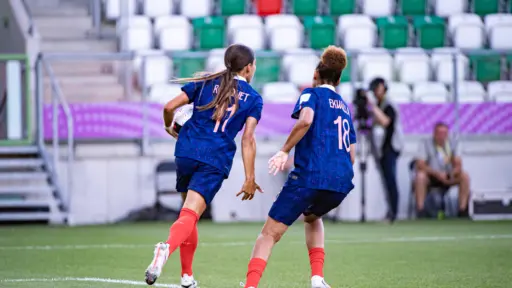
As expected, France also secured their place in the play-offs. It must be said, however, that in terms of their performance, they were not quite at their best. The French did not cope well with opponents who stifled their preferred transition play, and the unsettled Europeans often lacked their expected technical quality and defensive stability. They therefore still have plenty to think about ahead of the play-offs where they face China in the round of 16.
Venezuela and Zambia faced off in the match for third place. In an entertaining encounter, the winner was finally decided in the tenth minute of stoppage time by an acrobatic goal from Andrea Suárez, which meant that whilst the South Americans progressed, the African side were bidding farewell to the tournament.
The players who made the biggest impression: Mei Hanashiro (Japan), Wara Shimizu (Japan), Lea Motyka (France), Clelia Ducreux (France)
Group E
Final standings: 1. China (qualified), 2. USA (qualified), 3. Kenya (qualified), 4. Samoa (eliminated)
China finished the group stage with a perfect record. Whilst they put in relatively commanding and controlled performances against Kenya and Samoa, the real test of their quality came in the final match against the USA. The Americans had more possession and created significantly more scoring opportunities, but the Chinese were exceptionally effective at key moments and managed to punish their opponents, particularly with quick transitions after winning the ball, eventually winning 3:2.
The USA made a name for themselves primarily through their incredible attacking productivity. Right at the start, they thrashed Samoa 17:0, recording the biggest victory ever recorded at an 11-a-side FIFA World Cup across all age categories, and subsequently added a further six goals against Kenya. The central figure in the American attack was Maddie DiMaria, who scored eleven goals in just three matches. However, the final defeat to China showed that against a higher-quality and more efficient opponent, American dominance might not be nearly as pronounced.
View this post on Instagram
Kenya and Samoa battled it out for the final qualifying spot. The African side won convincingly 4:0 and, despite previous defeats to China and the USA, secured a historic place in the round of 16. Samoa, on the other hand, learnt the hard way on their debut just how great the gulf is between Oceania and world youth football, finishing the tournament without scoring a single goal, with a 0–28 goal record.
The players who made the biggest impression: Maddie DiMaria (USA), Yuxi Liu (China), Xiaotang Xu (China)
Group F
Final standings: 1. Spain (qualified), 2. Mexico (qualified), 3. Australia (eliminated), 4. Chile (eliminated)
It is very difficult to identify any major weakness in the Spanish team. They have won all three of their matches, each time by a two-goal margin, and have also demonstrated considerable squad depth. Furthermore, their attacking strength does not rely on a single goalscorer, but is evenly distributed amongst several players. The two-time world champions in this age group have thus once again confirmed that they must be counted amongst the main contenders for the title.
Mexico ultimately secured second place, though the path to it was not entirely straightforward. The team, which relies heavily on players who grew up in the USA, entered their second match without a point following an opening defeat to Spain and found themselves trailing Chile from the 12th minute. However, the Mexicans managed to turn the match around and subsequently secured their place in the next round with a narrow victory over Australia, against whom they demonstrated fighting spirit and the ability to win crucial battles for loose balls.
Australia, on their World Cup debut, began with a hard-fought 1:1 draw against Chile, followed by a defeat to Spain and the decisive clash with Mexico. They were far more competitive in that match, but creating chances and a lack of quality in the final third remained a problem. Chile were the group’s even bigger unlucky side, with their results failing to reflect their performances. They took the lead against both Australia and Mexico, but managed to secure just a single point from both matches combined and ultimately exit the tournament in last place.
The players who made the biggest impression: Elena Vizuete (Spain), Citlalli Reyes (Mexico), Dali Gorr Burchmore (Australia)
More Videos & Highlights
Watch the moments behind the story.
 2 min read QB Originals Exclusive: Franny Černá on growing up in the USA, representing Czechia and how mainstream media treat women’s football
 1 min read QB Originals LISAN ALKEMADE: PSV Eindhoven Goalkeeper on How Mainstream Media Treat Women's Football Goalkeepers
 1 min read QB Originals QB Break with Franny Černá | Coffee, Football & Life in Prague
 1 min read QB Originals “We Celebrated Like We Won the World Cup” - Klára Cahynová on Beating Barcelona
 4 min read Off The Pitch Focus on the pitch, relax in the paddock: These footballers are F1 enthusiasts
 4 min read Strong Story No longer a choice: Motherhood in modern women’s football
 2 min read QB Originals BARBORA VOTÍKOVÁ: First Czech Woman at Arsenal. On & Off the Pitch
 1 min read QB Originals First Game. New Country. Hattrick. Hallie Bergford Story
 1 min read The Best Actions NWSL expansion sides suffer defeats in season debuts
 1 min read QB Originals SUE SMITH: A True Pioneer of the Women’s Game
 Who shone in Morocco? U17 Women’s World Cup group stage review
 U17 Women’s World Cup 2026: Statistical leaders from the group stage
 What the first five rounds of the WSL have shown us
 U20 Women’s World Cup: Statistical leaders from the Group Stage
 A closer look at the U20 World Cup group stage: Who shone and who fell short of expectations?
 France women's U20 can take time to get going, but once they do, they are unstoppable
 Who leads the NWSL in top statistical categories?
 Not just Putellas: Seven WSL transfers to watch this season
Explore more from The Pulse
Keep discovering more stories from women's football.