For the badge. The story of building Borussia Dortmund
Although one of Germany’s biggest football institutions, Borussia Dortmund, long remained one of the few major clubs without a women’s side in the top division. And while the club is still playing in the third league, its plans and ambitions are already impossible to ignore.
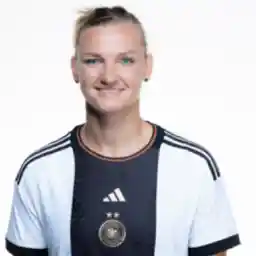
Shock. Alexandra Popp, Wolfsburg's very own legend and captain, says goodbye. In tears, wearing the captain’s armband. On 17 May 2026, against Nürnberg. At home, with a win, in front of her own fans. Exactly how a player of her stature should leave.
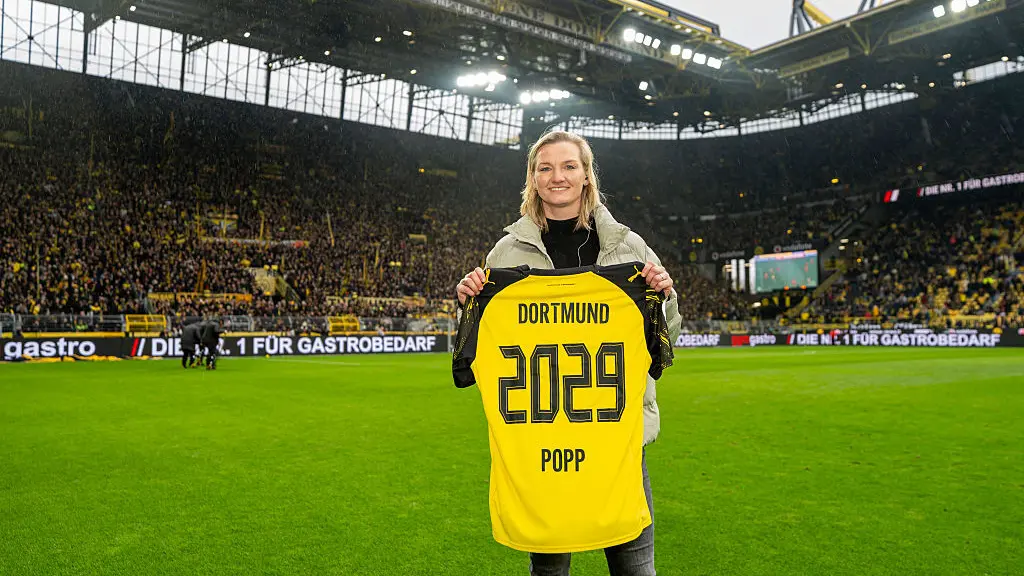
But Popp is not retiring from football. Quite the opposite. A major new challenge lies ahead. Together with familiar face Ralf Kellermann, she has taken on the task of bringing BVB to the top. It is a partnership with proven pedigree: the two experienced Wolfsburg’s greatest years together.
Too big a club to be missing
Borussia Dortmund only founded its women’s team in 2020. The project was handed to Svenja Schlenker, a long-time club employee who had previously worked in marketing for the men's team. Under head coach Thomas Sulewski, the newly assembled side entered the lowest Kreisliga division in the 2021/22 season.
Within the landscape of German women’s football, it almost felt absurd. Wolfsburg were dominating Europe. Bayern were right behind them. Frankfurt were attracting top players and eyeing European competition. Schalke and Hamburg were slowly building their momentum. And Dortmund? A club with millions of fans worldwide was starting life in the seventh tier.
Dortmund won their very first season without dropping a single point. They continued with similar dominance in the years that followed. Four consecutive promotions pushed the Schwarzgelben all the way to the Regionalliga, Germany’s third tier.
But the results are not the most interesting part. What matters more is how quickly the women’s team built its own audience, even while playing in the lower divisions. Their first home match in the Kreisliga attracted around 1,300 spectators. An absurd number for seventh-tier football.
And if there is one thing that always draws attention and brings in people who would not normally attend matches, it is a derby. BVB’s biggest rivals are Schalke, who are building an equally ambitious project. Their women’s team was also founded in 2020, meaning the Revierderby existed from day one.
Dortmund lost the first meeting and it was their first ever league defeat. But the return fixture at Stadion Rote Erde felt more like an event than a fourth-tier match. Ten thousand tickets disappeared almost instantly. Borussia came from behind to win 2:1 thanks to a goal from Annika Enderle.
A project attracting players without Bundesliga
Borussia are not even playing in the second division yet. And still, for several seasons now, they have been attracting players far above Regionalliga level.
Annika Enderle arrived from Essen. Dana Marquardt turned down the opportunity to fight for promotion to the Bundesliga with Hamburg. Defender Frederike Kempe came from Leipzig. Rita Schumacher brought Champions League experience from St. Pölten.
The reason is often the same: many of these players grew up supporting Dortmund. In men’s football, people constantly talk about “the power of the badge”. And that is exactly what BVB offers. The moment the project truly broke beyond being just a regional story came in the DFB-Pokal. After defeating Borussia Mönchengladbach, Dortmund were drawn against Bayern Munich.
The first ever women’s Die Klassikerin. 29 September 2025. Bayern arrived as reigning league champions. There was talk of moving the match to Signal Iduna Park, but in the end it was played at Stadion Rote Erde, where the women normally play. Even that was not enough. The club had to request a special exemption to increase capacity, and eventually 15,700 fans squeezed into the stadium. The highest attendance there in 52 years.
Bayern fielded their strongest possible lineup. No rotation. No underestimating the occasion. Pernille Harder scored twice and the favourites won 2:0. But the result was almost secondary.What mattered was something else entirely: Dortmund did not look like a third-tier team.
After the match, Bayern’s stars openly spoke about the respect they had for the project. Giulia Gwinn praised both the atmosphere and Dortmund’s organisation. Lena Oberdorf bluntly stated that BVB “is not a team that should be playing in the third division”. Pernille Harder highlighted the club’s ambition and the energy surrounding the project.
Promotion to the Bundesliga is still unfinished business. Dortmund are still fighting for a place in the second division, and the Regionalliga West remains an extremely demanding competition. But the club is already thinking far beyond that as shown by the arrivals of Kellermann and Popp. They could have bought the licence of a relegated club and skipped years of climbing through the divisions. Instead, Dortmund chose a different path.
In This Story
The players this piece is about.