Across the border: How the USA is shaping Mexican women's football
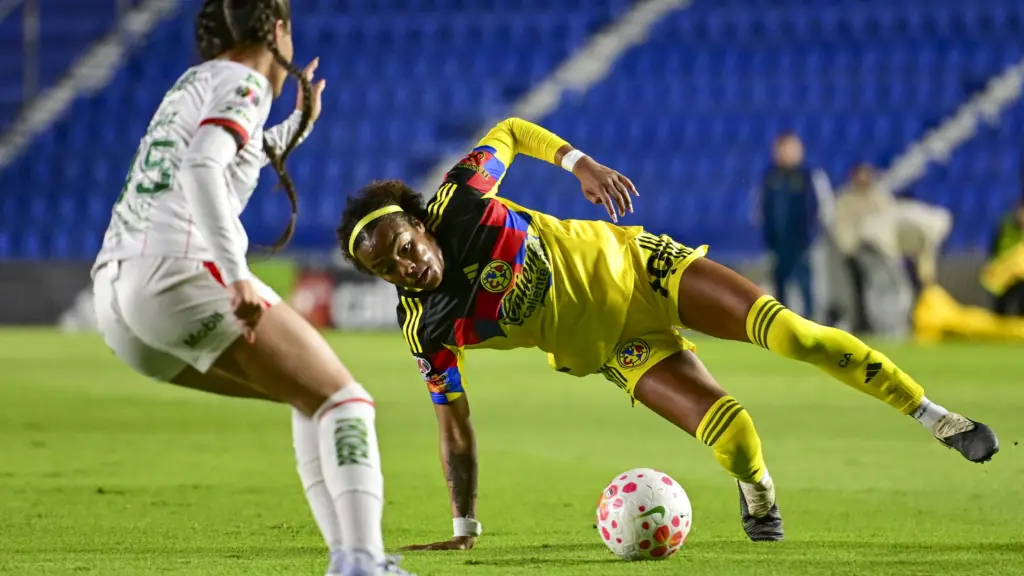
When browsing the profiles of Mexican women’s international players, especially the younger ones, one cannot help but notice an interesting fact: A significant proportion of them were born and developed their football skills in the United States.
In essence, this phenomenon is the inevitable and logical outcome of two facts. Firstly, the number of people of Mexican descent in the United States has long been very high. It is estimated that up to thirty-nine million people of Mexican origin currently live in the US, which undoubtedly makes them the largest ethnic group amongst the population with Hispanic roots.
Secondly, women’s football has enjoyed unprecedented popularity in the US for many decades. The top American league is indisputably among the three best in the world, the US national team has won the World Cup on several occasions in the past, and, moreover, it is quite possibly the only country in the world where football is considered the domain of girls and women. When these two factors are combined, the result is a large group of talented female footballers who, whilst growing up in a North American environment, can also represent the Mexican national team thanks to their family background.
Read also: These three players could shape Mexico's future
The first signs of this strategy can be traced back to the late 1990s and the early 2000s. Although at that time it did not yet involve organised recruitment, but rather players discovered individually and often by chance, the Los Angeles Times had already covered this practice as early as 2004. Therefore, this is certainly not a recent trend.
The number of players born and raised in the United States who feature in Mexican national teams fluctuates and varies from year to year. Whilst at times they can be counted on the fingers of one hand, at other times they make up almost half the entire squad. For example, in 2015, as many as 12 out of 24 players in the preliminary World Cup squad had this background. A year later, at the Under-17 World Cup, ten such players were selected, and in 2025, as many as nine featured in the same tournament. These are certainly not isolated cases, but a pattern that has a significant influence on the composition of the Mexican national teams.
The search for talent beyond the northern border
Nowadays, the Mexican Football Federation keeps a very good track of talented players from the US who hold, or could theoretically acquire, Mexican citizenship in the future: “There is a network of scouts from the Mexican Football Federation for each age group. Some work independently, are employed by clubs or by the federation itself, and monitor university and secondary school football. To find players abroad, scouts travel to the United States or rely on a network of contacts with local scouts,” explains Karen Poleth, Mexican football journalist and content creator, for Queenballers.
In addition, the federation regularly organises tours of the United States, during which it searches for talent with Mexican roots, as well as projects such as El Camino, which aims to identify and develop promising Mexican footballers living in the United States. However, football agencies also play an important role in drawing attention to promising players.
What has the American wind blown into Mexico?
As Poleth describes, the greatest contribution made by “American” players to the Mexican national teams is, above all, their playing profile, which brings diversity to the squad. At the same time, she emphasises that this stems from the different environment in which these players grow up, compared to those brought up in Mexico, rather than from the players themselves. In addition, they also bring experience of a higher degree of professionalisation, for example, greater experience of specialised physical training, an emphasis on the importance of nutrition and recovery strategies, and experience of medical care in a quasi-professional environment. This applies in particular to players who have had a taste of American university football, which operates at a near-professional level.
“Although Mexican university football does exist, it is not comparable to the American version, which is almost professional and has fitness coaches, physiotherapists and specialised medical care. In Mexico, there is often still a lack of coaches specialising in the female body, and the approach to injury care is different,” says Poleth, describing the situation in the country.
View this post on Instagram
Former Mexican international Renae Cuéllar also offers an interesting perspective on the contribution made by American women of Mexican descent, discussing the topic in 2019: „The difference is that we (Mexican-Americans) are very good athletes. They (Mexicans) are very good footballers, but they lack this aspect. So, when they play against the United States, Brazil or China, the players on those teams are athletes and very good on the ball. I feel I’m very dynamic and that helps me a lot. My level as an American athlete is very high, and in football terms, that really does help a lot here,” she said at the time.
The trend is also making its way into the domestic league
The presence of female footballers with Mexican roots who grew up in the United States is not limited to the national teams. They are also making an increasingly significant impact in the domestic top-flight league, Liga MX Femenil, which was established in 2017 primarily with the aim of supporting the development of players who have been brought up in Mexico itself. In 2019, however, the league also opened its doors to Mexican women born abroad, and in the very first season following this change, sixteen players, predominantly of Mexican-American origin, joined the competition. Some of them even had experience of international football.
Furthermore, Mexican clubs are actively seeking out players from the United States themselves. Their focus is primarily on the university leagues there, which traditionally represent an exceptionally rich pool of talent. For example, in 2022, América signed Scarlett Camberos and Nicki Hernández from the American university scene, whilst Tigres signed Maricarmen Reyes, who had shortly before celebrated a university title with UCLA. This trend continues to this day. Ahead of the spring half of the 2025/26 season, América were bolstered by Julie López from California State University, Long Beach, and Giana Riley, who has even represented the youth national teams of both countries.
From the pioneers to the current stars
Female footballers born or raised in the United States have left a significant mark on the Mexican national team across several generations. Among the pioneers was, for example, Teresa Noyola, who grew up in California, studied at Stanford University and played for the US youth national teams before deciding to represent Mexico. She wore the Mexican colours at the World Cups in 2011 and 2015. Her university team-mate Alina Garciamendez, a California native with Mexican parents, followed a similar path, even captaining the Mexican side at the 2010 Under-20 World Cup.
Even in recent years, there has been no shortage of prominent figures with Mexican-American roots. Kiana Palacios, a California native and graduate of UC Irvine, has become one of the most recognisable faces in Mexican women’s football and, whilst playing for América, established herself as the club’s all-time leading goalscorer before moving to Utah Royals. Scarlett Camberos also attended the same university and in 2026 became the first Mexican woman ever to be nominated for the Women’s Ballon d’Or. These examples clearly show that the USA is not merely a source of potential youth internationals with uncertain future potential, but a place where the stars of the Mexican senior national team and Mexican women’s football as a whole are nurtured.
What does the future hold?
How will the situation develop in the future? Will the number of Mexican women’s international players from North America continue to rise? That is rather difficult to answer. As Karen Poleth points out, factors supporting an increase in the number of these players include FIFA relaxing the rules on changing national teams, the growing number of scouts and agencies, and the fact that players with dual nationality are no longer counted as foreign players in the Liga Femenil. On the other hand, the quality of the Mexican league and of Mexican women’s football as a whole is also improving, which strengthens its ability to develop talented players domestically without having to rely on outside help.
Whatever happens in the years ahead, Poleth is certain of one thing: “The context of migration ensures that talent from the Mexican diaspora will continue to exist, but it will most likely remain a permanent addition rather than a replacement for local talent. These two sources (players raised in Mexico and those raised in the US) will therefore coexist.”
More Videos & Highlights
Watch the moments behind the story.
 2 min read QB Originals Exclusive: Franny Černá on growing up in the USA, representing Czechia and how mainstream media treat women’s football
 1 min read QB Originals LISAN ALKEMADE: PSV Eindhoven Goalkeeper on How Mainstream Media Treat Women's Football Goalkeepers
 1 min read QB Originals QB Break with Franny Černá | Coffee, Football & Life in Prague
 1 min read QB Originals “We Celebrated Like We Won the World Cup” - Klára Cahynová on Beating Barcelona
 4 min read Off The Pitch Focus on the pitch, relax in the paddock: These footballers are F1 enthusiasts
 4 min read Strong Story No longer a choice: Motherhood in modern women’s football
 2 min read QB Originals BARBORA VOTÍKOVÁ: First Czech Woman at Arsenal. On & Off the Pitch
 1 min read QB Originals First Game. New Country. Hattrick. Hallie Bergford Story
 1 min read The Best Actions NWSL expansion sides suffer defeats in season debuts
 1 min read QB Originals SUE SMITH: A True Pioneer of the Women’s Game
 Across the border: How the USA is shaping Mexican women's football
 Being a fan is hardest when things aren't going well. But that’s the point. A letter from an Arsenal WFC fan
 Women’s football stars call for change as U20 Women's World Cup scheduling leaves players behind
 Why is North Korea so dominant in women’s youth football?
 The physical difference that sets the NWSL apart from the Spanish Liga F
 Who helps with the grow of women's football? Check celebrities who invest in the NWSL clubs
 How much do NWSL clubs invest? A club-by-club breakdown
 What is behind Pau Gasol's historic investment in the Liga F?
Explore more from The Pulse
Keep discovering more stories from women's football.