
Opinion: Katie McCabe is a football villain. But women’s football needs her
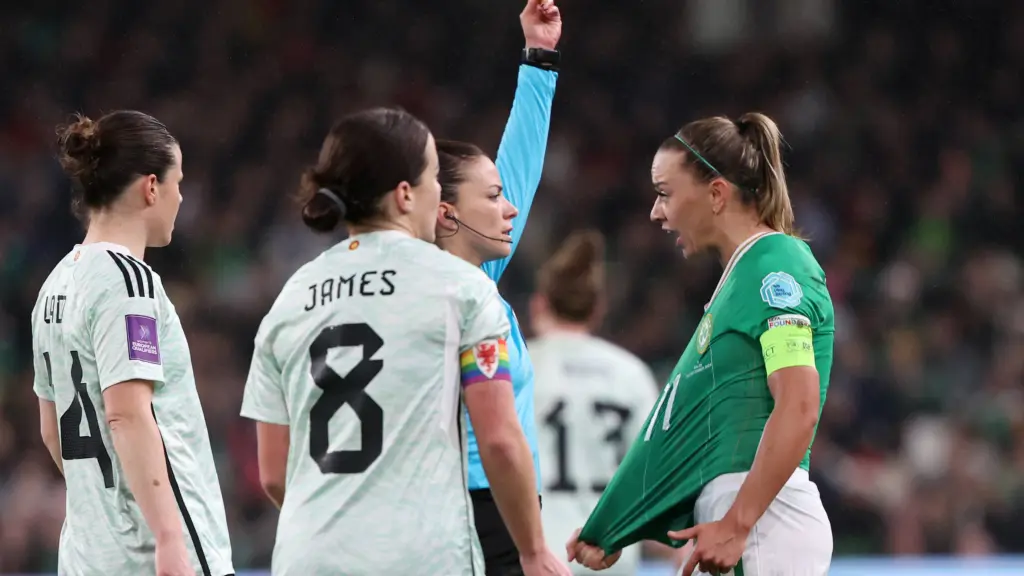
Few players evoke as much emotion as Katie McCabe. There are fans who love her, the other cannot stand her. McCabe is the type of player you adore when she plays for your team and despise when she plays against you. Men's football, meanwhile, is full of players like that.
A classic example is Sergio Ramos. Real Madrid fans absolutely adore him. To them, he is a club legend, a leader and captain to whom Los Blancos owe many of their greatest successes. For Real Madrid's opponents, however, Ramos was public enemy number one, a player they could not stand because of his frequent red cards and hard challenges that often crossed the line. Ramos was the quintessential football villain. Worshipped by his own supporters and hated by everyone else.
The same is true for Katie McCabe. Her leadership qualities are beyond question. During her eleven seasons at Arsenal, she often served as vice-captain whenever Kim Little and Leah Williamson were not on the pitch, and she also regularly wears the captain's armband for the Republic of Ireland national women's team. Arsenal supporters frequently regarded her as one of the key leaders of the North London side, where she became one of the club's most popular players.
One player, two faces
Alongside those leadership qualities, however, came hard tackles, frequent yellow cards and heated moments that irritated both opposition players and their supporters. You probably still remember the moment from the Women's Champions League quarter-final against Chelsea, when she pulled Alyssa Thompson's hair late in the match.
It was a controversial incident that was not punished with a red card, even though Kathrin Hendrich and Franziska Kett had both been sent off for similar offences. In McCabe's case, it was far from an isolated incident, particularly in high-stakes matches. In the FIFA Champions Cup final, one of her reckless challenges conceded a penalty that sent the trophy decider into extra time. In the 2024/25 London derby, another challenge resulted in both a penalty for Chelsea and a red card for McCabe, ultimately deciding an otherwise evenly contested match in favour of Arsenal's city rivals.
Another incident worth mentioning came during Arsenal's clash with Manchester City, when McCabe deliberately struck Chloe Kelly in the face with the ball. Fans brought the clip back into circulation when Kelly later joined Arsenal in January 2025. The players themselves, however, responded with humour: they recreated the scene, only this time McCabe did not hit Kelly with the ball but instead welcomed her to the club. It perfectly illustrated McCabe's dual nature: fierce on the pitch, but off it a committed teammate with a distinctive sense of humour that has made her popular among supporters.
Across eleven Women's Super League seasons, McCabe developed this dual identity. Arsenal fans loved her, while supporters of other clubs, especially their London rivals, could not stand her. That made her move directly from Arsenal to Chelsea all the more controversial. Many Arsenal fans were outraged that McCabe, who could easily have become a club legend even after leaving, used the chant Arsenal supporters had written for her in her announcement video before describing Chelsea as her dream club.
Chelsea supporters, on the other hand, who had spent years resenting McCabe for her hard challenges, have now enthusiastically welcomed her into their ranks. Despite her occasional excesses and lapses in discipline, they know their club has signed an outstanding full-back.
We love women's football because it gives us emotions, especially positive ones. Players are role models. That is particularly important because today's young girls growing up with football finally know female footballers who can make a living from the game. McCabe is undoubtedly one of those role models.
Why women's football needs players like McCabe?
At a time when women's football is still fighting for legitimacy, there is enormous pressure on everyone involved to be "better" than their male counterparts. More professional. More respectful. More humble. Female players often carry responsibility for the image of the entire sport in a way that male players rarely do. Every conflict is immediately judged as something that damages women's football. But is that really the case? Perhaps the moment women's football can afford to have its own villains is the moment it no longer needs to be a permanent advertising campaign for itself.
McCabe is not a villain because she is a worse person than everyone else. Perhaps she is only considered a villain because she displays qualities that we have become far less comfortable accepting in women than in men. If a man played the same way, we would call him a "master of the dark arts." We would describe him as an awkward opponent, someone willing to do anything to win. When a woman does it, she often becomes the problem.
That does not mean we should defend every one of her challenges or every aspect of her behaviour. Quite the opposite. A villain only works if they occasionally cross the line and spark a debate about where that line actually is. She is not interesting because she is always right. She is interesting because she forces everyone else to take a side.
In This Story
The players this piece is about.