

The minimum wage in Liga F lags behind
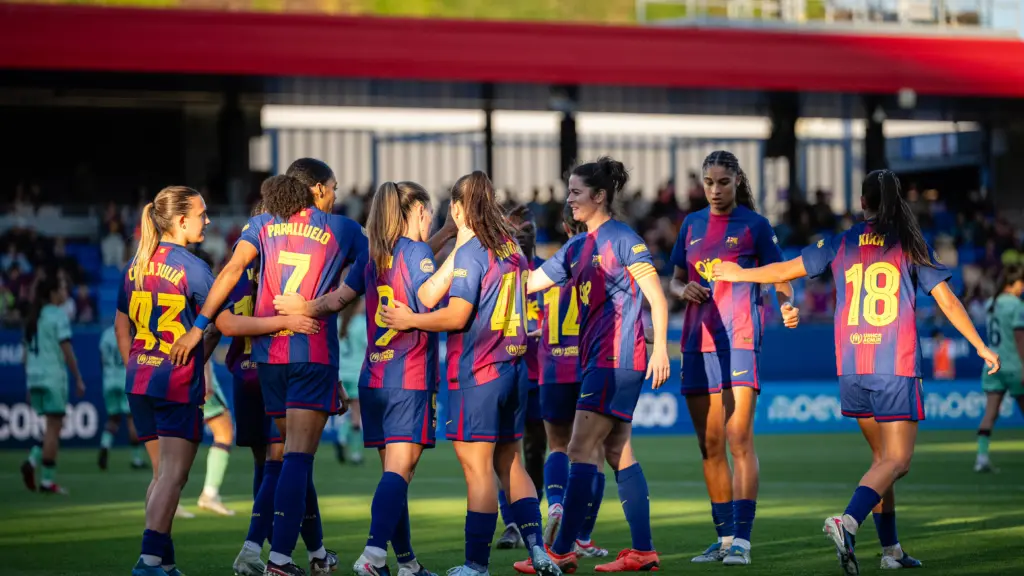
The departure of one of women’s football’s greatest icons, Alexia Putellas, to the English club London City Lionesses has reignited the debate about whether Liga F can compete financially with other European competitions. Although the Spanish league has produced a number of world-class female footballers and its clubs regularly compete for glory in the UEFA Women’s Champions League, it does not appear quite so dominant when one looks at the players’ pay packets.
What minimum wages does the collective agreement currently guarantee to female footballers, what safeguards does it provide, and why has its future now found itself at an impasse?
What does the collective agreement say?
The salaries of female footballers playing in Spain’s top division are currently governed by Liga F’s second collective agreement, which is still in force and came into effect in the 2023/2024 season. One of its main goals was to establish a three-year period during which minimum salaries would rise year on year. Whilst in the 2023/2024 season players were guaranteed a minimum gross salary of €21,000 per year, a year later this rose to €22,500 and in the recently concluded season it stood at €23,500.
This contract, which consists of around 42 pages in total, also offers the players other safeguards, such as a clearly structured plan for how to proceed in the event of pregnancy. In such a case, a female footballer has two basic options to choose from: not to renew her contract, or, conversely, to extend it for a further year, during which the club must guarantee her the same financial terms as before.
If the player chooses the second option, both the clubs and Liga F as a whole are also obliged to provide a lactation room on the premises where training sessions and matches take place, and to ensure that the child is looked after whilst their mother is taking part in a match or training session. If a player requests it, the league must also provide her with specialized prenatal and postnatal healthcare to help her return to the pitch as soon as possible: “No woman should be afraid of becoming a mother. I believe it’s a right that all women should have, and the last thing we need is to be pressured not to become mothers,” commented Beatriz Álvarez, president of Liga F, at the time.
Furthermore, in the event of injury or death occurring whilst carrying out their professional duties, players or their surviving relatives are entitled to financial support. If a player suffers permanent incapacity that prevents her from carrying out her usual profession (playing football), she will be paid a sum of €90,000. If the injury results not only in an inability to play football but also to perform any other profession, the player is entitled to €150,000. In the event of her death, her family is then entitled to €100,000.
Liga F is facing uncertainty
However, according to Beatriz Álvarez, the average salary is almost three times higher than the minimum wage and is thought to be around €60,000. It should be noted that the average salary figure may be rather distorted, as it also includes, of course, the salaries of the biggest stars, which are completely detached from the rest of the league. The highest-paid players in the 2025/2026 season were the reigning world’s best player, Aitana Bonmatí, with an annual salary of around €1,000,664, and Alexia Putellas, now playing for London City Lionesses, who, according to the published ranking of the world’s ten highest-paid female players for last season, earned approximately €709,583.
How salaries in Spain’s top league will develop from here remains a mystery for now. The second collective agreement for Liga F was due to expire at the end of June this year, with the third collective agreement to be negotiated immediately afterwards. However, the trade unions have not yet found common ground and have been unable to agree on exactly who should sit on the executive committee that will negotiate the new collective agreement. The dispute is likely to end up in court. The validity of the current collective agreement is thus de facto extended indefinitely, and unless there is some rapid development in the situation, it looks as though the players will have to content themselves with the same minimum wage threshold and the same conditions as in the previous season for the coming season as well.
The comparison reveals a devastating truth
When compared with other top women’s football leagues, Liga F does not fare well at all. The minimum wages in the NWSL and the Women’s Super League, which, along with the Spanish league, are regarded by many as the world’s best competitions, are almost double those in Spain.
Whilst in England, female players above the age of 23 are guaranteed a minimum annual income of €46,763, in the US the figure stands at €43,833 in 2026. Furthermore, the American system is designed so that minimum salaries will rise each year, reaching €71,593 by 2030. In this respect, Liga F does not even measure up to the Italian league, which guarantees players over the age of 23 an annual salary of €26,664.
Even greater differences can be seen when compared with Spanish men’s football. The minimum annual salary for La Liga players reached €195,000 in the 2025/2026 season. For second-tier players, the minimum is set at €98,000, and it is only in the third tier that one encounters a figure similar to that in Liga F. Third-tier players (at clubs with revenues exceeding €500,000) are guaranteed a minimum salary of €25,000 per year.
The statistics therefore paint a rather unflattering picture for Liga F. The Spanish league has long struggled to find a sustainable and satisfactory method of funding, for which it has come under particular criticism recently. The tension is also reflected in the visible exodus of key players from the two top clubs to other European teams, which is fuelling fears in Spain that the top flight may in future become more of a “farmers league”, from which players will flee abroad at the first decent opportunity to receive adequate financial rewards.
*The salaries listed for the English and American competitions may be slightly inaccurate due to fluctuations in the euro exchange rate.