

The growth of sponsorship revenue in the NWSL. How did it change since 2013?

When the NWSL first kicked off in 2013, there were only three official league-wide sponsors and one broadcasting partner who agreed to air just nine matches that season. The club themselves relied on small local partnerships for their front of kit sponsors, with each club having only one to two. Today, the league has 15 league-wide partnerships with brands and 12 media partners, including four broadcasters. More impressively, clubs’ individual sponsorships add up to over 400 brand partners.
To be fair, sponsors played a different role in the NWSL when operations first began in 2013. The league was founded as a place for US, Canada, and Mexico internationals to play when not with their national teams, and as such U.S. Soccer subsidized a lot of the operational costs, spending $526,000 on various expenses. At this point in the NWSL’s history, the league was not very ambitious in its spending — clubs were limited by a salary cap of $200,000, with a maximum individual salary of $30,000.
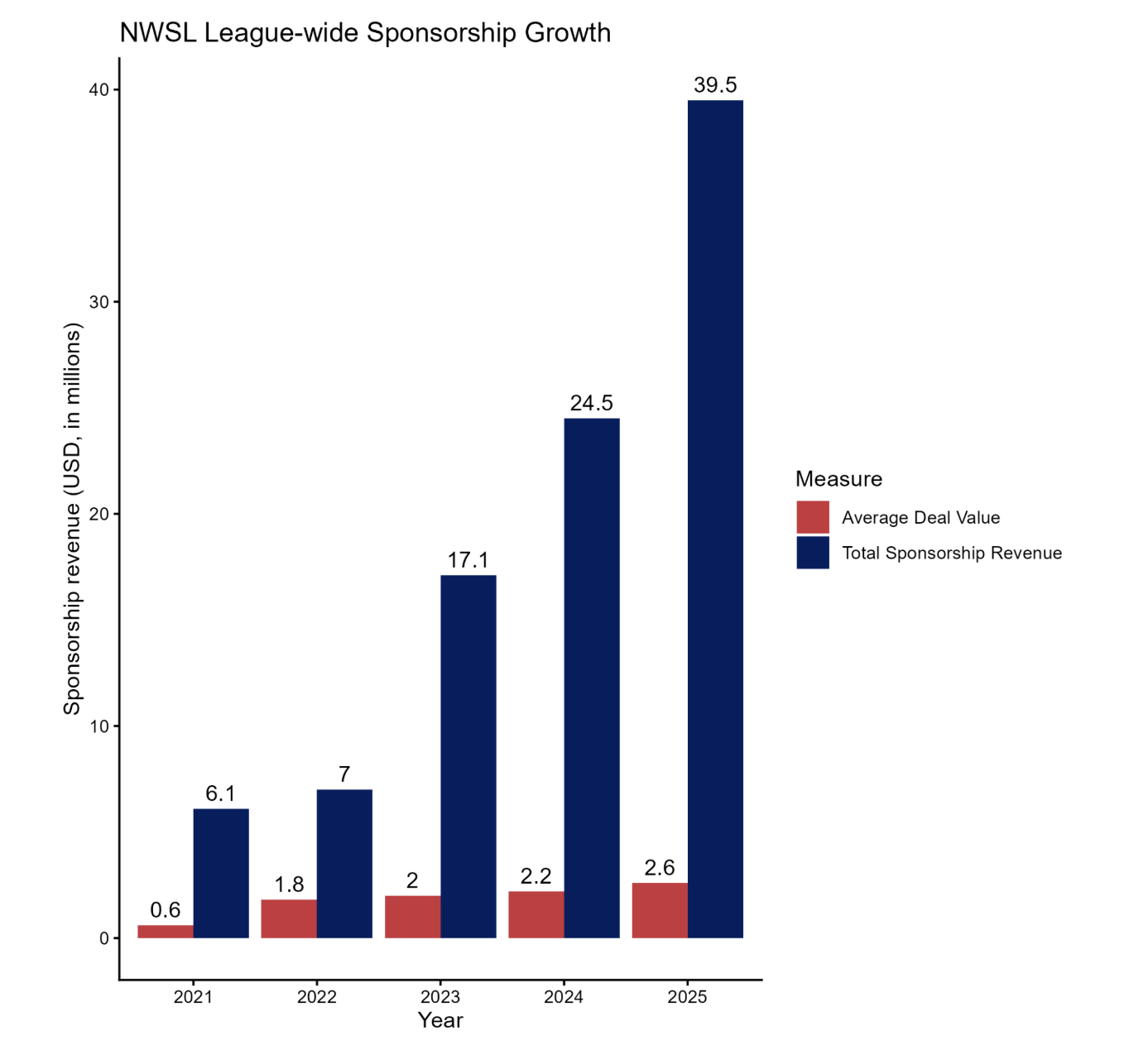
As the NWSL grew, and became more focused on becoming a proper football league for all players, so did its sponsorship revenue.
Women's football as an opportunity
League-wide sponsorship revenue in 2025 was over six times what it was just four years earlier in 2021, marking exponential growth in women’s football as a business opportunity in the United States. On the club side, sponsorship revenue hit $75 million last year. Angel City FC, the club with the most sponsorship revenue, outperformed 15 Major League Soccer (MLS) clubs and 25 Major League Baseball (MLB) teams.
In 2024, front-of-kit sponsorship deals were worth an average of $1.1 million, a number that has only grown with time. Similarly, clubs have an average of 31.5 sponsorship deals each, a far cry from the one or two partnerships that clubs had when the league was first starting out.
Interest in women’s football has been at an all-time high since the 2023 FIFA Women’s World Cup in Australia and New Zealand, and the NWSL league office and clubs alike have been well-poised to take advantage. As sponsorship revenue grows, the salary cap will grow. As the salary cap grows, clubs will be able to attract more and more global superstars. And as those global superstars make their way to the league, the sport as a whole will benefit exponentially in the United States.