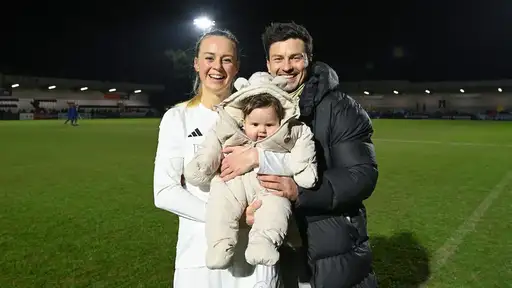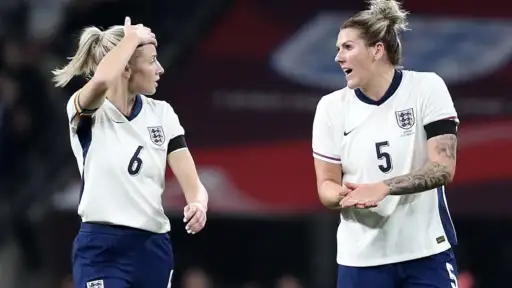
Sarina Wiegman's side will head out to Switzerland with the aim of retaining the trophy but will be up against it from the off. Standing between them and the knockout stages will be Netherlands, winners in 2017; France, semi-finalists in 2022; and neighbours Wales, who will make their major tournament debut on the women's side.
England knew a tough set of fixtures could be on the cards beforehand, as they were in Pot 2 for Monday's draw. Most fans would've been hoping to be placed in Group A then, with hosts Switzerland, rather than Spain, Germany or France. But the Swiss landed themselves a rather kind draw, while Germany will face Sweden, semi-finalists two years ago, and world champions Spain will take on an Italy side that will be a popular pick as a dark horse.
The tournament will get underway on July 2, with England's first fixture, against France, to take place on July 5. Games against Netherlands and Wales will follow on July 9 and July 13, respectively.
As the winner of The Best FIFA Women's Player for 2024 at the ceremony on Tuesday, Aitana Bonmati was the highlight selection for the top 11 of the year, with fellow Barca stars Irene Paredes, Ona Batlle, Caroline Graham Hansen, Salma Paralluelo and Patri Guijarro.
After a brilliant 16-year international career, the 39-year-old is hanging up her cleats for both club and country. Three-time World Cup participant, three-time Olympic Gamed participant and U.S. Women's national team legend Becky Sauerbrunn has announced her professional retirement.
The 39-year-old defender registered 219 caps across 16 years with the program, while on the club side, she participated in every single season of the NWSL since its founding, winning two championships (2014, 2015), an NWSL Title (2022) and an NWSL Shield (2021). Between 2013 and 2024, Sauerbrunn 167 of her 182 caps during that time frame, and overall, has the 10th-most in USWNT history.
It was announced last year that a second women's club competition would be introduced in Europe for the 2025-26 season, to sit under the Women's Champions League as the Europa League does on the men's side, and that it would take on a straight knockout format, but no name had been decided by that point. UEFA has now confirmed that it will be called the Women's Europa Cup and that it will have a two-legged knockout format.
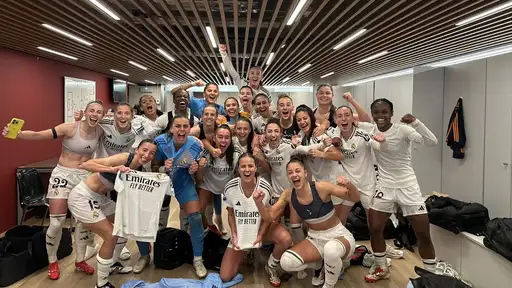
Real Madrid qualified for their fourth consecutive Women's Champions League group stage. They did so after qualifying from a preliminary play-off against Sporting CP, whom they beat in both matches. In the second leg, played at the Alfredo Di Stéfano, the Portuguese took an early lead, but a brace from Toletti and a superb goal from Alba Redondo allowed Toril's side to confirm their place among the 16 teams in Friday's draw in Nyon.
Both sides knew what was at stake, which was evident from the first minute. It was a lively start in which Sporting CP took the lead in the 5th minute from a free-kick taken by Andreia Bravo which, after being flicked on by Fatima Pinto, was headed home by Capeta. The visitors' joy was short-lived as Madrid's response was immediate. Feller stole the ball near the penalty area and combined with Weir, who pulled it back for Toletti to fire home with her right foot (1-1, min. 7).
Penalty not given
Shortly afterwards it was Misa who kept out another Portuguese strike with a reflex save to deny Capeta's close-range effort. In the 25th minute, Real Madrid claimed a penalty for a clear foul inside the area by Cláudia Neto on Feller, but the referee waved play on. Our team had the last chance of the first half with a deflected header by M. Méndez from a corner kick by Leupolz.
Right at the start of the second half, Toletti was on target again to complete the comeback and extend the lead. Weir set up the Frenchwoman for the second time, who struck a precise right-footed shot to make it 2-1. Tiredness would then take its toll on the tempo of the game, but the Lisbon side wanted to get back into the contest and it was Misa who kept them out with a couple of fine saves. In stoppage time, Alba Redondo's right-footed shot into the top corner made it 3-1 and sealed Real Madrid’s place in the Women's Champions League group stage.
The draw for this year's group stage was made on Friday and it has thrown up some tantalising fixtures. Reigning European champions Barcelona have been pooled with Man City, as the English side make the group stages for the first time since the competition changed format in 2021, while Chelsea, still chasing a first UWCL title, will take on Real Madrid.
PSG went into the second leg of this second round qualifier with plenty of work to do, having lost 3-1 in Turin last Wednesday. That task became even harder almost immediately when Sofia Cantore capitalised on the chaos caused by a Juve corner to put her team 1-0 up on the night, and even further ahead on aggregate, with only two minutes on the clock.
It took until after half-time for the Parisians to get one back, when Romee Leuchter converted from the penalty spot after a foul on Marie-Antoinette Katoto, but it did spark them into life a little. Korbin Albert was extremely close to reducing that deficit further when she struck the crossbar and then Jennifer Echegini forced a strong save out of Pauline Peyraud-Magnin.
However, set piece defending - or a lack thereof - proved PSG's undoing once again, Barbara Bonansea coming off the bench to dart completely unmarked to the near post and flick a header beyond Earps that killed the tie off with 18 minutes remaining.
Before the 2023 Women’s World Cup final the Fifa president, Gianni Infantino, urged women to “push at the doors” of power in their drive for equality. “With men, with Fifa, you will find open doors,” he said. “Just push the doors. I say to all the women – and you know I have four daughters, so I have a few at home – that you have the power to change.
“Pick the right battles. Pick the right fights. You have the power to convince us men what we have to do and what we don’t have to do. You do it. Just do it.”
A month later, in response to Infantino’s heavily criticised comments, the UK-based Women in Football, which has about 10,000 members, launched Open Doors. It calls on Fifa and other football bodies to mandate diverse leadership in national associations and work towards a 30% female membership of general assemblies and executive committees, the inclusion of independent non-executive members on executive committees, presidential term limits and action on sexism and discrimination in the workplace.
After one year of work with several clubs and federations, Women in Football reflected on the work with a discussion at the House of Lords, where its chair, Ebru Koksal, spoke with the Football Association chair, Debbie Hewitt, about the campaign and the importance of diverse boardrooms.
“Nobody wants the wrong kind of people in any boardroom,” the Women in Football CEO, Yvonne Harrison, says. “What we want is diverse boardrooms with great representation and the good boardrooms have got a skills matrix where you look at what you need for what the organisation is doing or where it’s going and you adjust your board accordingly.
“The key thing with Open Doors is for independent people on boards but let’s also make sure that the people on the boards are also really great people doing the right things and have got a common vision.”
Harrison believes Hewitt is the only independently recruited chair of a federation. “That speaks volumes, doesn’t it,” she says. “You’ve got to make sure it’s the right people and that’s what we’re working on with the European Club Association. We’re supporting senior women who are already working in football internationally, in clubs and in federations, with their professional development through a bespoke leadership programme.”
Why does that matter? “It’s about making sure when women do get into these positions or have the opportunity, they can deliver the best version of themselves. Debbie spoke quite a lot around the importance of having people looking out for you and mentoring and guiding you and that’s what we’re trying to do alongside the advocacy and advisory piece.”
Football governance is not known for having diverse representation in its leadership bodies. Harrison says clubs and federations have been the most receptive to Open Doors. “We have a stronger take-up from clubs and federations,” she says.
“There’s a lot of tact required there and it’s challenging within international bodies. There’s a lot of work to do here in the UK so we spend more of our attention here. We’ve had much more of a take-up from clubs and we’ve got some really exciting news coming over the next couple of months that’s come from our work with clubs and other organisations getting involved.”
Can it be frustrating constantly having to make the case for diversity in the boardroom in football when so many other sectors are further ahead in this space, and society even further? “It is frustrating in one sense,” says Harrison. “We shouldn’t need to look to other sectors where change has been made and where quotas or targets have been introduced. Even in sports generally there have been changes.
“With the UK Code for Sports Governance we’ve seen the representation of women on boards of bodies in receipt of public funding shift massively to the point that some of those targets are not in there any more because they don’t need to be. So, we know it works and we know that sometimes you just have to remind people of why it matters.
“There are brilliant examples of organisations doing it super-well and we often allude to them when we’re talking to new corporate Women in Football members, but football is very traditional. It’s moving, there’s a lot of change that’s happening, particularly within the women’s game, and the growth of the women’s game is making football think very differently. We’re excited about what’s to come but we’ll keep banging the drum.”