Elena Schiavo: The Italian rebel who changed the rules of the game
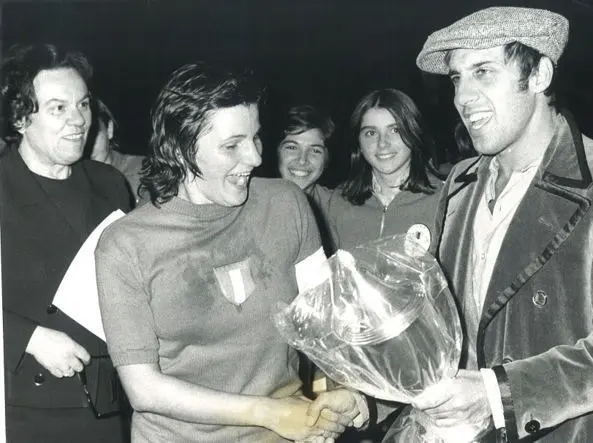
“I was a rebel.“ These are the exact words Elena Schiavo uses to look back on her extraordinary career. For her, rebellion wasn’t just a pose, it was a necessity. At a time when many in Italy believed a woman’s place was exclusively in the kitchen, she decided to go against the grain and devote herself to a sport that was considered a purely male pursuit.
The magic of football captivated her from a young age, and when the boys on the street tried to keep her away from the ball, she’d simply beat them up, and that was that. However, a much tougher opponent awaited her in the form of the prejudices of adults and society as a whole at the time: “When someone boos me because I’m playing poorly, that’s fine, it’s part of my job and the world of sports, but when someone tells me with a stupid grin to go home and knit, that insult hurts me deeply because it demeans my position as a woman in society,” recalls the woman who, despite all obstacles, became one of the most important pioneers of Italian women’s football and the first player in the country to negotiate terms resembling a professional contract.
In the 1950s, the prospects for girls who were interested in playing football were rather bleak in Italy. For a long time, Elena thought that football would remain just a fun pastime she enjoyed playing on the street, and given the circumstances, she began to focus on track and field, and it must be said, very successfully! Elena excelled in middle-distance races, winning several awards in the 400- and 800-meter races. She was selected twice for the national junior track and field team and once for the senior team.
The first professional female footballer in Italian history
The turning point came in 1963, when she managed to join one of the few Italian women’s teams: Furie Rosse de Cormons. About six years later, coach Vicenzo Leone spotted her at a practice and informed her that in Rome they were urgently looking for a replacement for their injured player Stefania Medri. Elena thus experienced a meteoric rise to the highest levels of Italian women’s football, which ultimately culminated in a national title.
This opportunity changed Elena’s life forever and allowed her to essentially become the first professional female footballer in her country’s history. Before her transfer to Real Torino, she made it clear to management that this was a major life step for her, and also a leap into the unknown, and that she therefore deserved at least some financial security. The result was an agreement that included a regular salary, bonuses for matches and national team call-ups, meals and housing, vacation time, and insurance. At the time, this was something absolutely unheard of.
In the following seasons, Elena accepted offers from countless clubs, and it’s no exaggeration to say that she left a significant mark on all of them. She won the league title a total of four times: with Roma in 1969, with Real Torino in 1970, with Falchi Astro in 1974 and with Valdobbiadene in 1976. Added to these achievements are two Women's Italian Cups in 1972 and 1973.
And what made Elena such an exceptional and desirable player? Above all, her technical skills, which were incredibly advanced for the time, as well as her determination and strength, which she gained from track and field. Schiavo also committed to a strict lifestyle, which was by no means the norm at the time. She tried to eat a balanced diet, went to bed early, or, as she herself put it, “didn’t stay up late playing cards,” as is customary in some parts of Italy.
Beginning in 1974, Elena began to experience recurring health issues and even had to undergo surgery. The final straw came five years later, when she returned to the pitch after a multi-game suspension, only to get injured again and receive another multi-game suspension for her protests. By that time, Elena already knew she had been hired by the local government as a civil registrar, so she decided it was time to leave football behind.
La capitana
The most significant mark Elena made on the history of Italian women’s football was as captain of the national team, which she led to medal finishes at the first two unofficial Women’s World Cups. At the very first unofficial World Cup, hosted by Italy in 1970, she led Azzurre all the way to the final, where they ultimately lost to Denmark 0:2. Paradoxically, her greatest fame came from the third-place finish at the 1971 Women’s World Cup in Mexico, which, despite considerable opposition from FIFA and other official football organizations, became a huge commercial success. At the time, women’s football matches drew crowds of fans to Mexico’s largest stadiums, creating an atmosphere for the tournament that was entirely on par with that of men’s football.
Back then, Italy faced France and Denmark in the group stage. While the Italians defeated Les Bleues 1:0 thanks to a goal by Schiavo, the match against Denmark ended in a draw, and Italy ultimately advanced to the semifinals as the second-place finisher. The semifinal turned into a massive drama that is still remembered as one of the most intense and memorable matches in the history of women’s football. Although Italy took the lead as early as the sixth minute, the Mexican team managed to turn the match around relatively quickly thanks to two penalty kicks. But despite considerable discontent from the home fans, the visiting players eventually earned a free kick. Although the position wasn’t particularly advantageous, Elena Schiavo managed to curl the ball into the net and tie the game. A couple of seconds later, however, came a shock when the referee disallowed the goal. The reason remains unclear to this day.
Some sources agree that the referees were instructed to push Mexico into the final, simply because it was commercially beneficial. On the other hand, some Mexican players still argue that the disallowed goal was entirely legitimate because the referee had signaled from the start that it was to be an indirect free kick, which Elena allegedly failed to hear and instead attempted to kick the ball directly into the goal. Whether this is true, we’ll probably never know. Nevertheless, in the third-place match, Italy crushed Argentina 4–0, and so the world’s best female player, as the media called Elena at the time, was able to return home with a smile on her face.
Recognition did not come until the 21st century
The tragic aspect of this national success is not so much the perhaps unfair loss to Mexico, but rather the way the women’s football team was treated in their home country upon their return. Although the tournament became a phenomenon in Mexico that swept the entire country off its feet, television stations on the Apennine Peninsula were not allowed to broadcast the matches, and even the print media tended to believe it was better to remain silent about women’s football. As a result, the Italian captain, now 78 years old, did not receive recognition until later in life. Although Elena was knighted in 1986 for her achievements in sport, she did not gain true national and international attention until recent years, when the media began to take a greater interest in her story.
In addition to interviews and podcasts, Elena also appeared, for example, in the book La Donna nel pallone by Caroli Angelo and became one of the main protagonists of a documentary dedicated to the aforementioned World Cup in Mexico, titled Copa 71. However, her greatest honor came just last year, when the organizations l’Unione Stampa Sportiva Italiana and il Movimento Cristiano Lavoratori awarded her a lifetime achievement award, placing her among the giants of Italian football such as Gigi Buffon, Claudio Ranieri, Giampiero Gasperini, Beppe Marotta, and Rolando Mandragora.