

“Respect Women’s Football”: Dijon’s fight for survival exposes a bigger problem we have to solve
Women’s football is growing. But especially in Europe, so much still depends on how clubs choose to treat their women’s teams. In some places, there is a genuine one-club mentality: women play at the big main stadium, have their own merchandise, and share facilities equally with the men’s side. Elsewhere, the reality is very different. At Dijon, despite the women’s team being more successful than the men’s side, the players are now facing the possible loss of their professional status.
On 22 April 2026, Dijon’s players walked onto the pitch with the club crest on their shirts covered by black tape. Why? Because they are deeply unhappy with how the club’s board has treated them. You would think that a team consistently finishing in the top half of the Première Ligue table, and even running for the title last season, would be valued and supported. Instead, according to the players themselves, they have felt unwanted from day one. And now, their future is uncertain. Proposed cuts could ultimately strip the team of its professional status altogether.
Reward for the best result?
The players refused to stay silent. Earlier in April, they published a statement named “20 Years of Effort Ending in the Indifference of an Absent Leadership.” In it, they outlined a series of grievances with the club hierarchy. Despite years of competing at the highest level, and even mounting a title challenge last season endig fourth as their best result so far, the club has not rewarded that progress by the club. Instead, money are being taken away from the women’s section, while priority continues to be given to the men’s team, which currently plays in France’s third division.
Perhaps most painfully, the players say club officials never even met with them face-to-face to explain the situation. Instead, they found out the plans through the club’s website. Players who had spent years giving everything for the badge suddenly found themselves fighting for the very existence of the team.
“To lead means to take responsibility, not abandon the ship. We play for this club. The club should fight for us. We deserve respect. Women’s football deserves respect. Today, you make the decisions — we live with the consequences,” ended players their statement.
Rivals on the pitch, sisters off the pitch
Yet amid the frustration, women’s football also showed its sense of solidarity. Proof that rivalries belong on the pitch, not off the pitch.
When Dijon faced OL Lyonnes on 22 April, Dijon’s players walked out wearing black shirts bearing the message: “Respect women’s football.” Before kick-off, they posed together with Lyon’s players in a powerful show of unity. Wendie Renard, one of Lyon’s legend and a big name of French football, publicly defended Dijon, calling the possible disappearance of the team “unacceptable.”
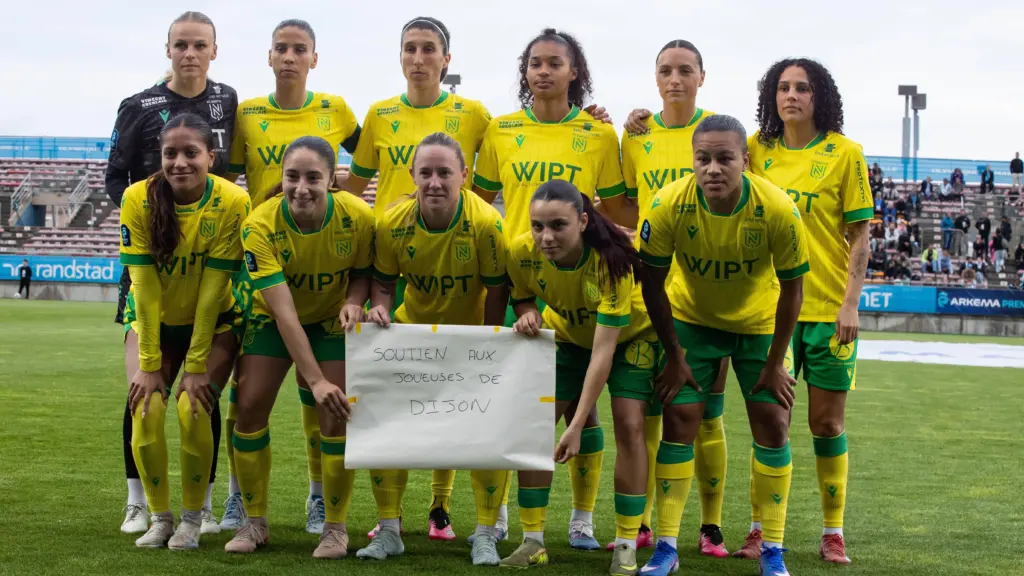
And the protest did not end there. Alongside the taped-over club crest, the match itself was symbolically paused in the 20th minute, marking the 20 years of existence of a women’s section now under threat. Other Première Ligue teams also showed support, with similar actions taking place across France in a sign of collective mobilisation. For example: Nantes posed with the sign supporting Dijon before kick off.
Because despite the rivalries, there is still something shared among all women’s footballers. No matter which club they represent or what colours they wear, they continue to battle the same prejudices, the same need to justify their existence even in the face of undeniable success.
Dijon’s leadership argues that, like many clubs, it faces financial difficulties and must rethink its operating model. But the obvious question remains: why should the women’s team, one of the club’s few sporting success stories, pay the price?
The women’s side was even backed by Dijon’s men’s team, currently top of the Championnat National and pushing for promotion back to Ligue 2. The men walked onto the pitch wearing the same black shirts carrying the message “Respect women’s football,” making it clear that they, too, disagreed with how the women’s section was being treated. The club, however, largely ignored the gesture and did not even acknowledge it on social media.
Can we do something about it?
All of this comes at a time when women’s football in France is clearly moving forward. The national team secured a bronze medal in the Nations League and stands in a strong position to qualify directly for the 2027 World Cup. OL Lyonnes, with eight Women's Champions League titles, remain one of the most successful clubs in the history of the women’s game and will fight for another European crown in Oslo later this month. And yet, in France, female footballers are still forced to fight for the most basic protections, including a proper collective bargaining agreement.
Even a historic season offers no guarantees. Success on the pitch is still not enough to ensure security off it. Women’s football no longer needs to beg for recognition, it has earned that through its performances. What it needs now is for owners and executives to stop treating it like a disposable line in a balance sheet.
Supporting local women’s teams today means more than simply buying a ticket. It is a statement: a way of telling club leadership that supporters see value where executives fail to. Because without respect for its own roots and achievements, any club, no matter how many trophies it wins, is ultimately just an empty brand.